MIL-STD TESTING


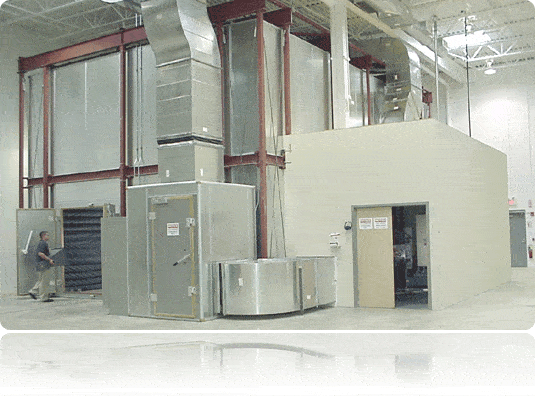
Mil Std 461 calls out the requirements for testing, including the use of shielded enclosures where the testing is performed. The shielded enclosure should be large enough to hold the equipment under test, and should be equipped to handle the requirements needed to perform simulation tests. Large test rooms can accommodate not only large items, but smaller ones as well. D.L.S. provides a unique flexibility, with 6 different shield rooms to perform Mil Std testing in, offering a number of different size rooms, including three that are 36' x 25' x 20'. Larger rooms can accommodate longer cable runs, which more accurately simulate the actual use of a device or system in the field application. Larger rooms also can allow taller devices to stand upright, as they would be intended to do in the application.


D.L.S. provides state of the art environmental control equipment to maintain applicable testing conditions. In the event of excessive heat build up while a device is operating or in applications where the device operating conditions are changing from one extreme to another, D.L.S. provides special cooling equipment. This can entail the use of outside fans, and special shielded intake areas to eliminate the chance of interference from the support equipment. D.L.S. is equipped to provide up to 15,000 cubic feet per minute airflow.


D.L.S. has the ability to operate equipment under test at maximum testing levels to ensure compliance to applicable standards. D.L.S. provides sound reduction annex rooms, ensuring a safe testing and friendly environment for engineering staff and equipment alike. These rooms, 11' x 20' x 12' allow for remote mechanical power to be brought in via a noise-controlled environment, without exposing personnel to high level audio noise.


D.L.S. can provide a wide variety of temperature control specifications. Occasionally, testing requirements involve the use of additional devices intended to simulate the use of a device in its expected application. Testing parameters need to be developed to ensure that the simulation presented is as real as possible to the actual operation in the field. This, in most cases, requires the activation and use of a device at the highest level of operation. Requirements such as cooling, with fans or ethylene glycol based chillers, must be located outside the test area. The D.L.S. ethylene glycol distribution systems and cooling chiller has a capability of 120,000 BTU (10 tons).


Testing procedures can also relate to potential hazards to testing engineers and other personnel. Only authorized personnel, actively involved within the test shall be permitted in the enclosure area. In some cases, testing procedures will result in potentially dangerous electromagnetic fields being generated. Permittable levels of exposure are identified in DOD 6055.11, and shall not be exceeded in areas where testing personnel are present. In all cases, safety procedures and devices will be used to prevent accidental exposure to potential hazards, RF or shock hazard. High voltage tests are often performed, and extreme caution must be taken by testing personnel to ensure safety precautions are observed at all times.

D.L.S. Electronic Systems, Inc. is an independent testing laboratory, accredited by an independent testing organization to ensure that the testing is performed within the United States Department of Commerce and the National Institute of Standards and Technology, which issues third party accreditations for testing and calibration under the National Voluntary Laboratory Accreditation Program, or NVLAP. This program follows the guidelines of ISO/IEC 17025. D.L.S. is listed under NVLAP Lab code number 100276-0.

Occasionally, specific applications can require specific personnel requirements. An example is the use of engineering staff accredited by National Association of Radio and Telecommunications Engineers, Inc., or what has been commonly referred to as NARTE. The US Navy, through NAVAIR to insure that their equipment was being tested correctly, established this program in the late 80's. This program exists today, with prospective engineers required to take and pass a written, certification examination test. Most NAVAIR related programs still require that the testing be performed, certified, or supervised by NARTE engineering staff. D.L.S. provides an experienced technical staff of 19 engineers, 16 of which are certified to the NARTE standards. These engineers are trained not only in test performance and methodology, but provide engineering assistance with respect to compliance failures, offering on the spot trouble shooting and problem solving experiences. D.L.S. was awarded NARTE's prestigious organizational certification.


Just a few of the D.L.S. Engineering Staff.
  D.L.S. offers a number of engineering solutions, stocked, and ready to be employed. The list of solutions includes, but is not limited, to EMI gaskets and seals, conductive paints and foils, cable shielding, ferrite beads and sleeves, chokes, capacitors, filters, and other materials and components used for compliance purposes. D.L.S. has a "pipeline" to customized solution providers, if such a need arises as well.  
 
 
  top of page

——————————————————————————————————————————————
Safety | EMC Services | Training | Maps/Hotels | Press Releases | Reports |  CE Marking | Contact Us | Links | Home | Site Map

D.L.S. Electronic Systems, Inc.
1250 Peterson Drive    Wheeling, IL 60090    847-537-6400 (phone)    847-537-6488 (fax)
D.L.S. Electronic Systems, Inc. Copyright ©2008, All rights reserved
Questions, Comments, or Suggestions? Contact Marc Hess: mhess@dlsemc.com